The Belief That Dogs Reincarnate as Humans
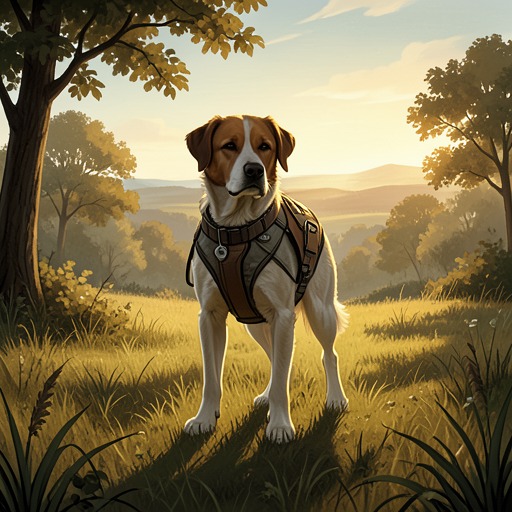
The Art of Racing in the RainThe Belief That Dogs Reincarnate as Humans is Enzo’s account of a dog’s soul passing into a human life when its time as a dog is complete. Learned from a televised documentary and held as a personal truth, the belief makes death a passage rather than simple disappearance. It also gives Enzo a purpose: he tries to prepare for human life while confronting the possibility that becoming a man will cost him the memories and relationships that have made his present life meaningful.
The Documentary and the Mongolian Account
Enzo traces his understanding to a documentary about Mongolia broadcast on the National Geographic Channel. He accepts its account as true: when a dog dies, the master expresses the wish that the dog return as a man, and the dog’s soul is allowed to travel freely before its next incarnation. The documentary’s account makes the interval between death and rebirth part of the belief, not an empty void. The soul can run across open land for as long as it wishes before it is ready to begin another life.
The qualification matters to Enzo. The program says that not every dog returns as a man; only dogs who are ready do so. He applies that condition to himself, insisting that he is ready. His certainty is based neither on a human explanation nor on proof that others can verify. It rests on a television program that he regards as having clarified the truth, and on his sense that his own inner life is already different from that of other dogs. The narrative presents this as Enzo’s conviction, while allowing the conviction to organize how he understands aging, death, and what may follow.
Preparing for Human Life
Enzo distinguishes the dog’s body from the soul he considers his true self. He has always felt almost human, regarding his canine form as a shell rather than the measure of his identity. In his account, rebirth will bring not merely a new body but a different capacity to act: he imagines looking at human hands, with thumbs able to close around fingers, and already knowing how to use them.
That anticipated transformation is also a threatened loss. Enzo expects to lose all his memories and experiences when he becomes a man. He longs to carry forward what he has lived through with the Swift family, but recognizes that he has little control over what survives. His response is to force himself to remember and to imprint his knowledge as deeply as possible on his soul. The image of memory carried without pages or a physical surface gives the belief its central tension: the soul may continue, but the life that formed it may not remain consciously available.
His preparations are practical as well as spiritual. Enzo works on walking with a human gait, practices chewing slowly, and studies television for clues about how people behave and respond to situations. He imagines that these efforts will make him nearly an adult in understanding as soon as he is born, even though his new body will still need time to mature. The conviction therefore turns ordinary observation into rehearsal. His silence, which prevents him from explaining what he knows to the people around him, becomes one reason to imagine a future in which he can speak and participate as a person.
The Belief Within Family Life
The distinction between canine instinct and Enzo’s claimed humanlike will appears in his relationship with Zoë. Eve warns that a dog might bite a running child, while Denny insists that Enzo would never hurt his daughter. Enzo agrees that he can restrain instincts that might govern other dogs, and avoids rough play so Eve will not worry. The belief in a human soul gives Enzo a language for this difference, though his account also grounds it in choices and behavior rather than in an abstract claim alone.
His sense of what dogs can perceive further complicates the boundary between animal and human understanding. Enzo detects a decaying odor near Eve’s head before the family learns of her illness through medical examinations, but he cannot tell them what he has sensed. The episode does not establish reincarnation; instead, it shows the gap between his confidence in his inner knowledge and his inability to communicate it in human speech. He can perceive and interpret, yet remains dependent on gestures and on what others choose to understand.
After Eve dies, Enzo briefly acts in ways he understands as a return to animal existence, explaining that he could not bear to remain humanlike in the face of his grief. The moment exposes a limit in his hoped-for transformation: human feeling does not place him outside animal life, and his identity moves between the two rather than resolving cleanly into one. His belief can hold that tension, treating both the dog’s embodied instincts and the soul’s anticipated human future as parts of a single existence.
Death, Memory, and Readiness
Enzo’s belief shapes how he interprets Eve’s death as well as his own. In a dream, he sees Eve’s soul leave her body with her last breath and continue elsewhere. The vision echoes the documentary’s account of a soul released from the body, extending the idea beyond dogs. For Eve, Enzo understands death as the end of a painful struggle; for Denny, he recognizes, it begins a period of grief. The belief offers a spiritual image of continuation, but it does not erase the loss that the living must face.
When Enzo grows old and his body declines, the prospect of continued life through medication and physical support does not seem to him like a desirable reprieve. He does not want to be kept alive as his body fails. The belief in a next life gives that refusal a framework: he is not imagining a future in which the present body is restored, but a passage toward another kind of existence. His readiness, however, is not absolute. As death approaches, he thinks about how much Denny will miss him and would rather stay in the apartment with Denny and Zoë, watching people below them. Attachment pulls against the promise of rebirth.
At the end, Enzo recalls the documentary’s assurance that a dog’s soul is released into the surrounding world to run through fields, wind, rivers, rain, and sunlight until it is ready to be reborn. The image brings the belief back to its beginning, but its force has changed: readiness is no longer simply Enzo’s confident declaration about becoming a man. It is a hope he holds alongside his love for those he is leaving. His idea of reincarnation thus gives the novel a way to imagine continuity after death without making separation painless or making memory secure. What may endure is the soul; what Enzo most wishes to preserve is the life and love that have given that soul its meaning.